
Japan in 2026: a country moving forward, but differently
- Jan 20
- 5 min read
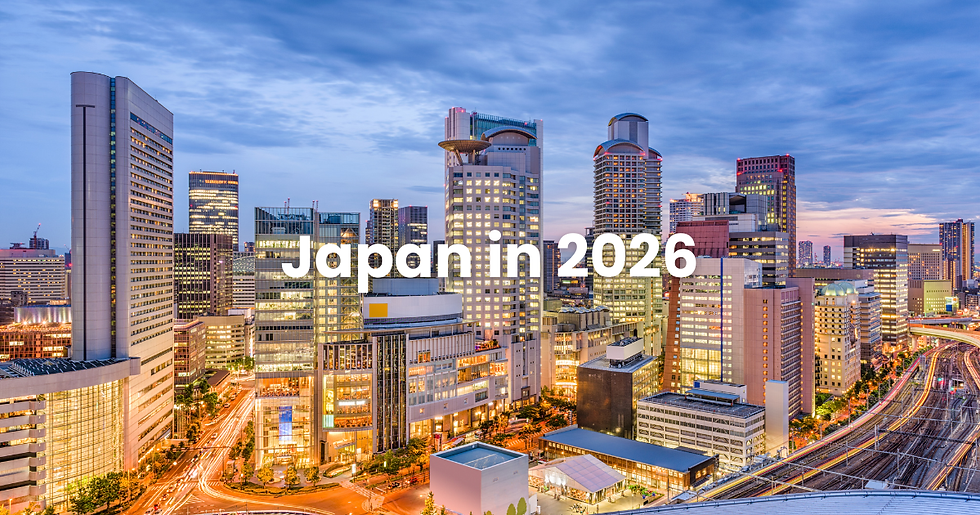
There is always something perplexing about the way Japan navigates periods of transition. Where other countries display visible breaks, spectacular speeches, or thunderous reforms, Japan moves forward on tiptoe.
Yet, in 2026, something is clearly happening. Not a revolution, but a profound, almost silent shift in its economic, social and territorial model.
At first glance, the indicators are reassuring. The Japanese economy is progressing, slowly but surely. Growth remains moderate, inflation is stabilizing, wages are rising, and unemployment remains very low. From the outside, the country seems to have regained a form of equilibrium after the shocks of the pandemic and global geopolitical uncertainties.
But this interpretation is misleading if it focuses solely on the figures. Because behind this apparent stability, Japan is now facing structural limitations that it can no longer ignore.

An economic recovery under constraints
By 2026, Japanese growth is primarily domestic . Consumption is gradually recovering, driven by improved purchasing power linked to rising wages and a slowdown in inflation (Japan Outlook 2025). After decades of wage stagnation, this development marks a significant psychological turning point. Companies, facing a chronic labor shortage, no longer have a real choice. They must increase compensation to attract and retain talent.
The labor market, in particular, is one of the clearest indicators of the tensions to come. With an unemployment rate around 2.5%, Japan is close to what economists call "frictional full employment." In other words, there is virtually no reserve of labor left that can be quickly mobilized. The working-age population is shrinking, the aging population is aging rapidly, and productivity gains have not yet fully offset this contraction.

In this context, the economic recovery is real but fragile . It rests on a delicate balance between consumption, investment, and innovation, in a country where every adjustment takes time. Japan can no longer rely on traditional expansive levers. It cannot massively increase its population, endlessly expand its infrastructure, or limitlessly broaden its service offerings.
The return of inflation: a cultural as well as an economic shift
For a long time, Japan lived in a world apart: a world of deflation. Stable, or even falling, prices were the norm. By 2026, that era is over. Inflation is slowing, but it is settling in at around 2%, a level that would have seemed almost inconceivable ten years earlier (Japan Outlook 2025).
This change has profound effects. It alters household behavior, business strategies, and even the relationship to economic time. Buying today rather than tomorrow is once again seen as rational. Investing is no longer perceived as an excessive risk. But this inflation also highlights territorial inequalities , particularly in major metropolitan areas.
Tokyo, in particular, is experiencing a marked increase in rents, much faster than in the rest of the country. This real estate pressure is linked to several factors: population density, short-term real estate investment, but also the influx of temporary populations, whether students, professionals, or tourists (Japan Outlook 2025). Here again, Japan is reaching a limit: the capacity of its major cities to absorb ever-increasing flows.

Tourism as a symptom, not as a cause
It is in this context that the explosion of international tourism must be understood. In 2025, Japan surpassed 40 million foreign visitors, an absolute record. The government's target for 2030 is set at 60 million, but already, signs of saturation are clearly appearing (Japan Outlook 2025).

Tokyo and Osaka are reaching hotel occupancy rates close to their operational ceiling. Infrastructure is no longer keeping pace with demand. The construction sector, like the hotel and restaurant industry, is experiencing a critical labor shortage. Unlike in the 2010s, the capacity for rapid expansion of supply is now very limited.

It would be wrong, however, to blame tourism for these tensions. Rather, it acts as a catalyst , highlighting pre-existing weaknesses: labor shortages, excessive urban concentration, rigid regulations, and slow structural adaptations.
Faced with this situation, Japanese authorities are beginning to shift their approach. The goal is no longer simply to welcome more visitors, but to increase the value generated by each visitor . In other words, to move from a quantitative to a qualitative approach (Japan 2025 Perspectives).
From quantity to value: a strategic turning point
This shift is fundamental, and it goes far beyond the realm of tourism. It reflects a broader realization: Japan can no longer grow in volume. It must grow in intensity .
This logic is found in many areas. In industry, investment is focused on high value-added technologies, particularly in semiconductors, artificial intelligence and automation (Japan Outlook 2025). In services, priority is given to quality, user experience and personalization.
In the regions, this strategy translates into a greater desire for rebalancing. Regions, long neglected in favor of large metropolitan areas, are once again becoming spaces for experimentation. They offer what large cities can no longer provide: space, time, and a different relationship to work and daily life.

A society under tension, but pragmatic
On a social level, Japan in 2026 is rife with silent tensions. The aging population is no longer a projection; it's a daily reality. Healthcare services, local infrastructure, and businesses must constantly adapt.
Yet, the country does not project the image of a stagnant or anxious society. On the contrary, it is moving forward with remarkable pragmatism . Automation is progressing rapidly in sectors facing labor shortages. Women's and older workers are being valued more highly. Working methods are evolving, slowly but surely, towards greater flexibility.

This constant adaptation is costly, complex, and sometimes frustrating. But it reflects a rare ability to integrate constraints rather than deny them. Japan is not seeking to recapture an idealized golden age. It is seeking to make its model sustainable in a world radically different from that of past decades.
A country that no longer tells its story, but is transforming itself
What is striking when observing Japan in 2026 is the contrast between the depth of the ongoing transformations and the discretion with which they are taking place. Few grand pronouncements, few dramatic breaks. Change is diffuse, gradual, sometimes almost invisible.
And yet, it's there. In the way the country is rethinking its growth. In its approach to tourism, no longer as an end in itself, but as one element among others in a broader balance. In its desire to create value without seeking expansion at all costs.
Japan in 2026: a silent laboratory
Ultimately, Japan in 2026 is neither in decline nor in a phase of euphoria. It occupies a fascinating middle ground: that of a country that has reached maturity, confronted with its limitations, but determined to transform them into opportunities.
For those who take the time to observe it, Japan appears as a discreet laboratory of the challenges that many developed societies will face in the coming years: aging, scarcity of human resources, saturation of large cities, the need to produce less but better.
This is not a country that seeks to impress. It is a country that adjusts, refines, corrects. Slowly, sometimes too slowly in the eyes of some, but with profound consistency.
In 2026, Japan is not promising a spectacular future. It is offering something else, perhaps rarer: a concrete reflection on how to continue moving forward when expansion is no longer an obvious option.


Comments